
367 Indexed Pages: What Our Search Console Report Tells Us

Opening Google Search Console can make a small business owner want more of every green number. More indexed pages. More videos. More clicks. At Scarborough House, we want those things too. We also want to know exactly what the numbers mean before we decide what to build next.
Our October 22, 2026 screenshots show 367 indexed pages, about 2.32K pages not indexed, and eight reported reasons for exclusion. A separate video report shows 11 indexed and six not indexed. Those are useful observations. They are not proof that 2,320 pages are broken, or that six videos need to be moved onto our homepage.
The short answer: increase the number of useful, distinct, public pages that Google can discover and index. Do not try to make every URL green. Redirects, duplicate addresses, and deliberately private pages can be excluded for good reasons.
367 indexed pages is a dated observation, not a promise
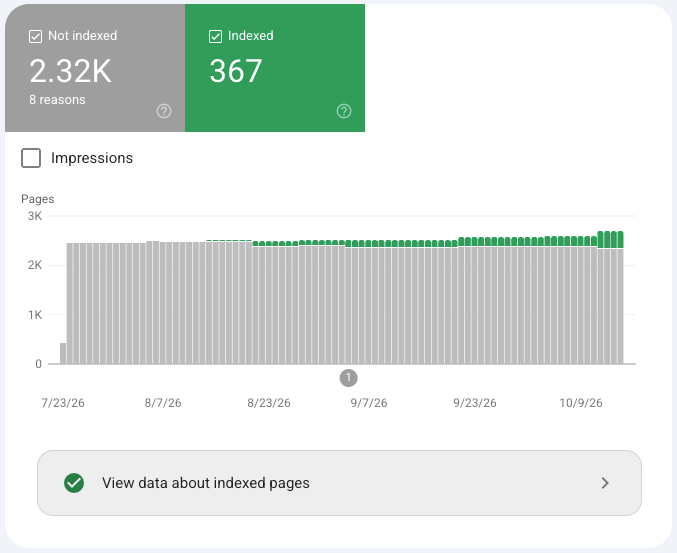
The first useful discipline is separating a screenshot from a forecast. This image establishes the count displayed when it was captured. It does not establish the exact time each URL changed state. It does not tell us which individual pages entered the index, or whether every page we care about is included.
It is also different from a sitemap count. A sitemap lists pages we want Google to discover. Search Console reports what Google knows and has indexed. Publishing a page, adding it to a sitemap, and seeing it indexed are three separate milestones.
Google's Page indexing documentation says the goal is to index the canonical version of each important page. It explicitly says not to expect every URL to be indexed. That is a more useful target than turning the entire gray section green.
The gray section needs its reason rows
Eight reasons can contain very different jobs. A redirect might correctly send an old address to its replacement. A duplicate might correctly consolidate into the preferred page. A deliberately excluded account page should not become public merely to improve a dashboard number.
Other states deserve investigation. An important public article that is discovered but not indexed calls for a different review from a page blocked by today's robots rules. A historical blocked result may describe an older crawl, not the page's current behavior. We need the reason, example URL, canonical choice, and last crawl date together.
The uploaded overview does not include those eight reason tables. We cannot honestly assign their totals, declare a dominant cause, or promise that one technical change will recover the entire excluded group. The next useful export is the actual reason breakdown, followed by examples from each meaningful category.
Improve the page a real visitor would choose
For a wedding venue, a useful page answers a real planning question. How does the weekend work? Where do overnight guests sleep? What does the package include? What does the outdoor reception space look like in an actual wedding?
That gives us an editorial test before a technical one. Does the page have a purpose that is different from an existing page? Does it contain accurate, specific information? Is there a sensible route to it from a related part of the site? Does its title describe the actual content?
Our event capacity and lodging guide, lodging information, and weekend package serve different questions. Creating ten near-identical versions of one of them would produce more addresses, not ten new answers. A useful addition needs its own reason to exist.
Google's spam policies distinguish helpful content from doorway abuse and scaled content made primarily to manipulate rankings. The practical lesson is simple: publish another page when it helps someone, not when a counter needs another unit.
Check the response, not just the page in a browser
A public page needs a working address, appropriate indexing permissions, a sensible canonical URL, and content a crawler can access. A browser showing a page does not by itself verify those details. A successful sitemap submission does not verify them either.
JavaScript is not automatically a barrier: Google can render JavaScript, but rendering and resource availability can introduce complications. For important venue information, providing meaningful initial HTML makes the content easier to inspect and reduces reliance on a later rendering step. That is a practical engineering choice, not a claim that every JavaScript site is invisible.
We also need real status codes. A removed address should not return a generic homepage with a success response just to avoid an error count. A genuine replacement can use a relevant redirect. An address with no replacement may correctly remain absent.
Eleven indexed videos is a separate report
Thinking about touring? Most couples know within the first ten minutes on the grounds. See tour times or check pricing first.
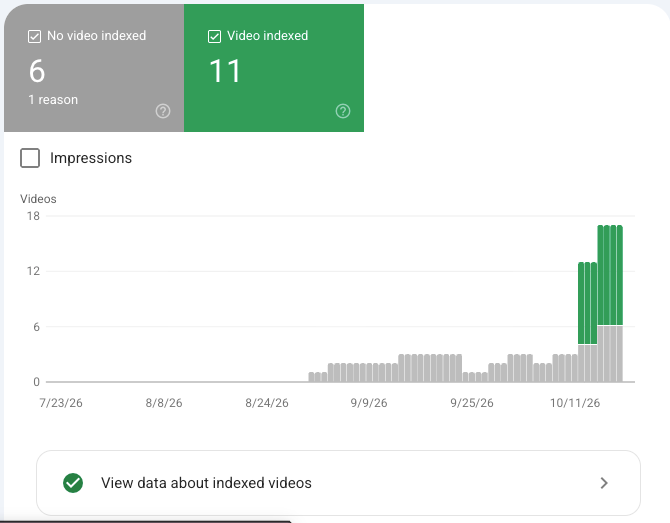
A webpage can be indexed while its embedded video is not selected for video indexing. Those are not contradictory results. A venue homepage may primarily introduce the property. An article may primarily explain a planning decision. An embedded film can support either page without making watching that film the page's main purpose.
Google's video guidance recommends dedicated watch pages when they make sense. The film should be prominent, playable, and the main reason to visit. The page needs its own useful title and description, accessible thumbnail, and accurate video information.
That is why our video library is a better destination for a person wanting to watch films than a random article with a player added to its footer. We should improve genuine watch pages, not turn every useful article into a video page.
Do not diagnose six entries from one overview
This screenshot shows one video-indexing reason, but not its name or affected URLs. We will not invent that missing detail. We also will not assume the six entries represent six unique video files; the report concerns pages and Google's detected videos on them.
An earlier, separately dated review of our video pages found supplemental embeds on ordinary pages. That history can guide what to inspect, but it does not replace the current report's detail rows. Each new claim needs current evidence.
Adding verified films, useful descriptions, and accurate chapters can improve the library. Inventing transcripts or creating several thin pages around the same clip cannot establish that the content is more helpful. Repeatedly requesting indexing cannot guarantee selection.
The achievement screenshot adds a different measurement
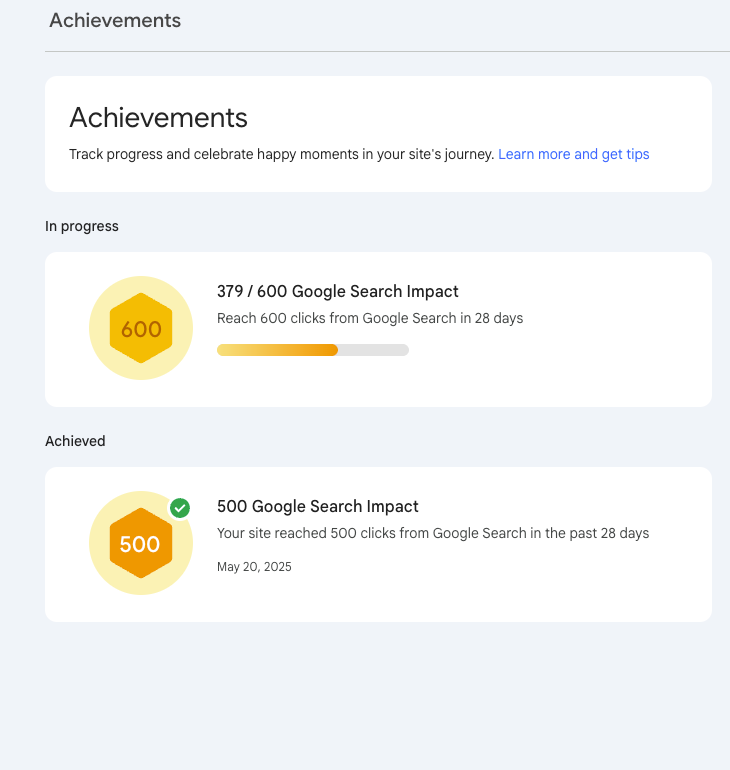
The screenshot's 379 is not another indexing total. It is progress toward an achievement based on Google Search clicks. The older 500-click badge records a past milestone. Those two cards do not establish that current traffic has grown from 379 to 500, or that a new 600-click goal has already been reached.
Click reporting, video-index counts, webpage-index counts, website sessions, and confirmed tour bookings are different measures. We can learn from each without adding them together or treating one as proof of another.
What we will measure next
The next useful comparison is a stable set of important URLs: their current response, canonical, last crawl, and Google index status. Alongside that, compare clicks, impressions, and click-through rate over equivalent performance windows. Note when a change was prepared, when it was published, and when Google next observed it.
Our goal is more people finding an accurate answer and taking a sensible next step. That might mean reading the pricing details, browsing the real wedding gallery, or arranging a venue tour. A bigger index can help when it represents better coverage. The coverage, not the number alone, is the work.
This is one part of our Tech Talk field notes on building a venue website. The evidence is real, the report has limits, and the next action should follow both.